Your browser doesn't support javascript. This means that the content or functionality of our website will be limited or unavailable. If you need more information about Vinnova, please contact us.

Framtidens precisionsmedicin

Explorativa samverkansmiljöer som möter framtidens behov

Call text for the offer

Tip: To create a PDF with all the information about the offer click Ctrl+P and select PDF to save the content.

  • The precision medicine of the future

    With this the call for proposals Vinnova wants to finance collaboration and innovation to create the precision medicine of the future.

    In the future, everyone can live a long life in health based on their circumstances. Precision medicine is a natural part of healthcare, where each patient receives diagnostics and treatment that is designed and adapted to their unique needs and conditions. The individual's conditions for health and well-being are taken care of and improved in an equal and sustainable way.

    How can your environments help and contribute?

  • The call for proposals aims to support the development of pioneering methods in precision medicine. Vinnova finances innovation environments that develop innovative and accurate diagnostics and treatment in collaboration with the end user. The call for proposals also aims to strengthen the funded environments' ability to scale and further develop their results nationally and internationally so that they are eventually introduced into healthcare.

    We offer funding of approximately 4-6 million per year for three years to establish or further develop ambitious cross-sector innovation environments that contribute to precision medicine. The requested funding amount must be between 15–16 million per environment for the three years.

    The innovation environment must consist of at least three actors where two of the following sectors must be represented: academia and companies, where at least one of the companies must have a place of business in Sweden. In the environment, clinical relevance and the end user's perspective can also be represented by the public sector and healthcare providers, institutes and idea-based organisations.

    International organizations that do not have a place of business in Sweden can be part of the innovation environment, but cannot then receive funding from Vinnova.

    The actors seeking funding must have prepared a joint proposal and planned for a structured and active leadership.

    The call for proposals has an estimated budget of approximately SEK 80 million for the three-year innovation environments. If space is available at Vinnova, there may then be the possibility of additional financing for a selection of the environments.

  • Expected effects of the call for proposals

    The expected effects of the announcement are to contribute to:

    • Accurate diagnostics and treatment that are adapted to the individual.
    • Stronger structures for collaboration to develop precision medicine.
    • Increased internationalisation within the research and innovation system.


    Effect logic in the short and long term for the innovation environments

    Short term - Innovation environments with international collaboration that effectively contribute to specific objective.

    • Contribute to accurate diagnostics and treatment that is adapted to the individual.
    • Ambitious sustainable innovation environments that stimulate cooperation, build trust and respect, increase the innovation capacity between relevant actors to develop precision medicine.
    • Attractive innovation environments with a gender equality plan that attract talent ( actors), are cited internationally and increase internationalization within the research and innovation system.

    Long term - Innovation environments that create success stories that have an impact nationally and internationally.

    • Contributes to other large investments, opens up innovation uptake and business opportunities.
    • Environments that gather, connect, catalyze the ecosystem and thus strengthen international competitiveness and luminosity.
    • Internationally recognized and economically sustainable environments that have received national or international funding. The environment contributes to success stories, such as new companies and patents, for more efficient and accessible individual-centered care.

    Important aspects

    The innovation environments must support the development of pioneering methods in precision medicine.

    Vinnova finances innovation environments that develop innovative and accurate diagnostics and treatment in collaboration with the end user. The call for proposals also aims to strengthen the funded environments' ability to scale and further develop their results nationally and internationally so that they are eventually introduced into healthcare. The call for proposals should contribute to making more results freely available to everyone, and scientific publication of results should take place with open access.

    The environment is expected to contribute to a national and international ecosystem for the development and implementation of precision medicine. The environment should actively lead or participate in the EU's research and innovation programs as well as other international forums. This creates added value through increased visibility, access to internationally leading competence, the opportunity to find new customers and suppliers and access to increased funding. Complementary international funding also provides increased opportunities for long-term economic stability and stimulates the environment to greater risk-taking and higher ambitions.

    Added values of participating in the EU framework program

    Vinnova is tasked with promoting sustainable growth and community development. Genom Agenda 2030, the countries of the world have agreed on a global agreement and understanding of what characterizes sustainable development. Through our efforts, we contribute to the global commitment to reach the goals.

    Read more about our work to contribute to the goals of Agenda 2030

    In Inom Agenda 2030, Vinnova has specifically identified climate and gender equality as two central sustainability perspectives to which our funded investments should contribute positively. Project financed by Vinnova are therefore expected to take special account of sustainability such as social, economic and environmental, as well as gender equality aspects. See section 8 under the potential criterion for more information.

    Gender equality is a prerequisite for sustainable growth and is included in Agenda 2030, as an objective in itself but also as a perspective that should permeate the work with all objective.

    The call for proposals should therefore contribute to an equal social development linked to two main perspectives:

    • That both women and men take part in the grant in an equal way, participate in and have influence over the innovation environments in the call for proposals. See under the actor criterion in section 8.
    • To analyze and take a position on whether there are equality aspects such as sex or gender that are relevant linked to the innovation environment's problem area, solutions and utilization. This question is mandatory for all applicant and can be found under the heading "Project information" in Vinnova's e-services (application portal). In this call for proposals the question is the basis for assessment. See section 8 under the potential criterion.

    Read more about what our work for equal innovation means for those of you who seek funding from us

    Important equality aspects to take into account within the innovation environment

    The innovation environment must have drawn up an equality plan no later than two years after the start date.

    Horizon Europe guidance on gender equality plans - Publications Office of the EU
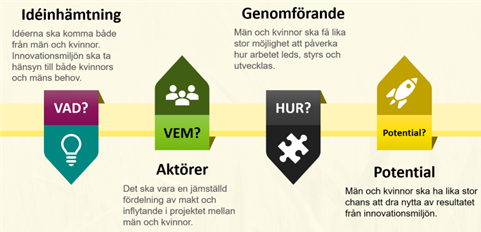
    Equality aspects

  • The call for proposals addresses a group actors, a so-called actor constellation, with a common vision and strategy for the development of precision medicine, where the end user's perspective must be represented. The constellation of actors must show how the knowledge and experience they develop must be put to good use in business and society.

    The actor constellation must consist of at least three actively participating organizations, so-called "project parties". The actor constellation must be represented by academia and company, where at least one of the companies must have a place of business in Sweden. Furthermore, the constellation of actors may include representatives of, for example, the public sector and healthcare providers, institutes, idea-based organizations, and foreign organizations.

    Vinnova looks positively on actor constellations consisting of parties with activities in Sweden and foreign parties. Foreign organizations with a branch or place of business in Sweden can be beneficiary. In that case Eligible costs must be attributable to the Swedish place of business. Foreign organizations with their own funding without a branch or place of business in Sweden can advantageously constitute an actor from a sector, but cannot then receive funding from Vinnova.

    Vinnova will attach particular importance to how the environment relates to other national and international initiatives. From an international perspective, we are particularly interested in the EU, USA and UK, but actors from other countries that are relevant to the environment's international connectivity can also be included.

    Leadership and core team

    Vinnova believes that a well-functioning environment requires active leadership, with an appointed leader, an appropriately designed steering group and an active collaboration between relevant parties. Parties with different perspectives (sectors) must together form a core team within the innovation environment.

    Vinnova believes that important success factors for the core team are:

    • Manage different interests within the environment.
    • Understand the driving forces of the individual actors and at the same time get specialists to work for the whole.
    • Create a dynamic environment where the actors work together and cross-sectorally, both nationally and internationally.
    • Create a value base and community based on collaboration and learning.
  • Activities for which funding can be applied for

    Vinnova's funding will primarily finance activities related to research and innovation that can eventually be used in healthcare. A smaller part can be used for coordinating the environment if basis for support allows it.

    Coordination can for example include:

    • Costs for all types of meetings.
    • Dissemination of results or participation in relevant international forums.
    • Activities to form and participate in international consortia and calls for proposals.

    Activities for which it is not possible to apply for funding:

    • Basic research.
    • Business development.
    • Commercialization and marketing of products or services.

    Eligible costs

    Our funding takes place through funding. Funding for organizations that carry out economic activities is covered by rules on state support. The rules govern, among other things, which types of costs and what proportion of them may be covered by funding.

    Read more about government support on our website

    I Vinnovas Anvisning to eligible costs it is described which costs are eligible for support for each basis for support.

    See our general terms and conditions for funding and a guide to the conditions for eligible costs

    Foundations of support

    In this call for proposals funding will be granted with support of one of the following support bases:

    • Research and development within the categories industrial research or experimental development in accordance with Section 9 (2015:208) on support for research and development and innovation and Article 25 Commission Regulation (EU) No. 651/2014 of 17 June 2014 (GBER ). It is the activities in the environment that determine the basis for support funding is granted. Actors should indicate according to which basis for support they seek funding.
    • Funding is granted in accordance with § 2, second point of the regulation (2015:208) on government support for research and development and innovation. The grant is granted as support of minor importance also called de minimis support in accordance with the EU's de minimis regulation. Read more on Vinnova's website about de minimis support.
      Please note that the maximum permitted support of minor importance is EUR 200,000 per recipient in the last three tax years. To calculate the maximum allowable support, all funding granted under the EU's de minimis regulation must be added together. funding for other parts of the group must also be included in this calculation. However, if you have received support according to GBER, you should not count on this. In order to be granted this support, you therefore need to submit a certificate of de-minimum support. The appendix can be downloaded from the call's webpage.
    • Not state aid in accordance with § 5 regulation (2015:208) on support for research and development and innovation. Organizations that do not carry out economic activities cannot be granted state aid. This generally includes universities and university colleges, research institutes and other organizations that do not offer any kind of service or product on a market. An organization that does not seek state support is ultimately responsible for the assessment that it does not carry out economic activities.
  • In this call for proposals we offer funding to ambitious cross-sector innovation environments with SEK 4 to 6 million per year for three years.

    Maximum aid intensity* per actor can be granted as follows, see list below.

    * Aid intensity is the same as Vinnova's funding expressed as a percentage of the beneficiary's eligible costs.

    Maximum aid intensity per actor that can be granted funding in this call for proposals
    • Non-economic activities*
      Basis for support: Non-state support - Aid intensity: 100 percent
    • Small business
      Basis for support: Experimental development - Aid intensity: 60 percent
      Basis for support: Industrial research - Aid intensity: 80 percent
    • Medium-sized company
      Basis for support: Experimental development - Aid intensity: 50 percent
      Basis for support: Industrial research - Aid intensity: 75 percent
    • Large company (≥250 employees)
      Basis for support: Experimental development - Aid intensity: 40 percent
      Basis for support: Industrial research - Aid intensity: 65 percent
    • Organizations with economic activities
      Basis for support: Support of minor importance, also called de minimis support - Aid intensity: 100 percent

    *With economic activities, it is intended to offer goods or services on a market. If the research organization or healthcare provider conducts both economic and non-economic activities, it is required that costs and funding in the respective activities can be clearly separated from each other. If there is no separate accounting, the organization is considered a company. The fact that an organization is not for profit is not decisive for whether the organization carries out economic or non-economic activities. What matters is whether you offer a product or service on a market.

    See the user guide on the definition of SME company
    See term and maximum allowed support for eligible costs, per beneficiary, in percentage in table of support levels

  • Conditions for us to assess proposal

    We will only assess applications that meet the following formal eligibility requirements:

    • All actors are legal entities. Note that sole proprietorships or sole traders are not legal entities.
    • At least three actors from two different sectors where companies and academia must be represented. At least one company must have a place of business in Sweden, see section 4 for more information.
    • Proposal must be written in Swedish or English.
    • The project description must be written in the template found on the call's website and according to its instructions.
    • The requested amount for the entire innovation environment must be 15–16 million over three years.
    • Proposal must contain CVs for the environment's leader, project manager in proposal, and representatives for all parties. Maximum one page per person.
    • Attach certificates of support of minor importance (de minimis) according to instructions in section 5 if such funding is sought.
    • Proposal does not contain any attachments in addition to the mandatory attachments.
    • Proposal have been received no later than 1:59 p.m. on the date stated on the announcement page on Vinnova's website.

  • What do we assess?

    The applications are assessed based on how well they fulfill aim of the call through the criteria potential, actors and implementation.

    Potential
    • Relevance in relation to the call's aim and objective. See description under section 3.
    • Contribute to accurate diagnostics and treatment for healthcare.
    • Be innovative or significantly better than what is already on the market.
    • Stimulate cooperation and increase innovative capacity nationally and internationally.
    • Potential to contribute to sustainability (social, economic and environmental).
    • Potential to contribute to increased gender equality.

    Actors
    • The ability and commitment of the innovation environment to achieve the set goals.
    • The leadership's competence, ability and commitment to lead and organize.
    • Ability to anchor the environment's work and establishment in different ways.
    • How well the end user's perspective is represented in the actor constellation.
    • The actors' international network and partners.
    • How well the team's key personnel are composed with regard to gender distribution, as well as the distribution of power and influence between women and men.

    Feasibility
    • National and international strategic analysis, as well as credible description of how the environment relates to other initiatives.
    • Relevant and realistic implementation plan, which includes plans to further develop the environment's results both nationally and internationally.
    • How well equality aspects have been integrated into the implementation.
    • Communication plan that clarifies the environment's objective, openness, inclusion and visibility.
    • Risk analysis, both inside and outside the environment, and action plan.

    How do we judge?

    The assessment takes place in competition between received applications according to the above criteria. The applications that meet the formal requirements under section 7 are assessed by Vinnova's specially appointed experts and internal evaluator at Vinnova.

    In cases where a proposal is judged to be relevant for funding, the actors behind proposal can be invited for an interview. See dates under "Important dates" on the call's webpage. Proposed leaders of the environment as well as representatives from the core team, all key stakeholders, are expected to attend. The interviews aim to clarify any ambiguities in the applications and clarify the cooperation between the participants in the environment. Vinnova then decides on funding.

    Our decision to grant or reject a proposal is sent to those who have applied funding and Vinnova publishes information about granted applications at www.vinnova.se.

  • About our decisions

    How much each party within the innovation environment is granted in funding is shown in the decision. Funding will be granted with support of the EU Commission's regulation no. 651/2014 as experimental development, industrial research (Article 25), de minimis in accordance with Section 2 of Vinnova's aid scheme and the de minimis regulation, or non-state aid in accordance with Vinnova's instructions. The basis for support appears in the decision and also governs which costs are eligible for support.

    Our decision to grant or reject a proposal cannot be appealed.

    Term for granted funding

    For granted funding, our general terms and conditions for fundingapply. The terms contain, among other things, rules about project agreements, conditions for payment, follow-up, reporting and utilization of results.

    Current term can be found on our website, along with help to understand and comply with the terms

    Scientific publication must take place with open access in accordance with Vinnova's instructions.

    For everyone who is granted funding in this the call for proposals the following special instructions also apply:

    • The innovation environment must be represented at any seminars or program conferences that Vinnova will organize during the funding period. Costs for participation in such a seminar or program conference are an eligible cost.
    • If necessary, the innovation environment must provide Vinnova with image and text material for project catalogues, annual reports and the like for which the actors hold usage rights.

    Supplementary special conditions can be decided for individual innovation environments.

    Pay extra attention to follow Vinnova's term. Deviations from these can in the worst case mean that you become liable for repayment. This also applies if you have been granted funding incorrectly or with too high an amount.

  • This is how you apply

    To apply for funding, you fill in a web-based form in Vinnova's e-service for applications, which you can find via the button Apply here.

    There you also upload the following attachments:

    • Project description - Precision medicine of the future. Follow the instructions in the template.
    • CV for the key people in proposal. Maximum one page per person.
    • For organizations seeking support of minor importance (de minimis), the certificate for this must be attached to proposal.

    Templates can be found further down the page under Attachments.

    Keep in mind that it takes time to make a proposal.
    You can start filling in information, save and continue at a later time. When proposal is ready, you mark it as done. You can completely unlock proposal and make changes at any time, right up until the application deadline.

    Please mark proposal well in advance before the call for proposals closes.

    When the call for proposals has closed and proposal has been registered with Vinnova, a confirmation will be sent out by e-mail to you who are responsible for the user account, project manager and company signatory or head of department. It may take a few hours before you receive the email.

    If you have not received a confirmation by e-mail within 24 hours after the call for proposals has closed, please contact us.

    When the application period has expired, completion of proposal can only take place upon request from us.

    Checklist

    Checklist for applicants where all answers must be Yes.

    • Through research, innovation and collaboration, should you contribute to the development of ground-breaking methods, where accurate diagnostics and treatment are developed in collaboration with the end user?
    • Are all actors seeking at most the maximum percentage of their total eligible costs for the basis for support they intend to receive funding for?
    • Is the end user's perspective taken into account?
    • Are important international aspects included?
    • Is the requested amount for the innovation environment between 15–16 million for the three years?
    • Does the environment contribute to increased gender equality and sustainability?
    • Does the environment contribute to structure and networks to spread and scale knowledge and experience outside their own organizations?
    • Do you have a risk analysis?

    The following questions are an eligibility requirements for your proposal to be assessed:

    • Are at least three actors involved in the innovation environment?
    • Are companies and academia represented in the innovation environment?
    • Does at least one company have a place of business in Sweden?
    • Are all actors legal persons?
    • Are Vinnova's project description template and CV template filled in correctly?
    • Bifogas CV for the environment's leaders and representatives of all actors?
    • Have you looked over Vinnova's support bases and adapted proposal based on this? Is a certificate of de minimis support required?
    • Is proposal written in Swedish and/or English?
    • Does proposal contain only the mandatory attachments and no other attachment?

    Please note that within the framework of this call for proposals the following are not funded:
    Costs for basic research, business development, commercialization and marketing of products or services.

  • Precision medicine

    In this call for proposals we use the same definition of precision medicine as in the government's life science strategy from December 2019: "Precision medicine refers to diagnostic methods and therapy for individually tailored investigation, prevention and treatment of disease, applied at the individual level or to parts of the population. The new opportunities that precision medicine offers are based on recent years' progress in, among other things, molecular biosciences ("omics" technologies) and bioinformatics, as well as the advent of new high-resolution imaging techniques."

    A national strategy for life science

    Innovation environment

    A flexible collaboration structure with established control mechanisms that gather actors around a common roadmap, target picture and activities.

    sustainability

    • Refers to economic sustainability - aspects such as everyone having to afford healthcare.
    • Social sustainability – aspects such as health and medical care must be equally individualized without discriminating according to the seven grounds of discrimination in Section 5 of the Discrimination Act.
    • Environmental sustainability – aspects such as minimizing environmental emissions in the production of precision health.

    Gender equality

    See section 3 for more information.

    Ecosystem

    All actors within the chosen area who are relevant and important to be able to reach, and who are affected by, the innovation environment's vision and strategy.

    Sectors

    Categorization of actor types is done in this call for proposals in six sectors:

    • Big companies.
    • Small and medium-sized enterprises, according to the EU definition.
    • Academy, for example universities and university colleges.
    • Public sector and healthcare providers, for example authorities, regions, municipalities as well as public and private healthcare providers.
    • Institution. Non-government or university-based research institutes.
    • Idea-based organisations, for example interest organizations and industry organisations.

Last updated 15 February 2024